 Top Trending
One Soft Chew a Day: Three Lines, Three Studies of Three Sizes
A blueberry-pomegranate chew from HumanN, sold by GNC: beet root powder, a grape-derived resveratrol and coffee fruit. I read each line beside its study, and wrote down what each study actually measured.

This is a paid advertisement. Sponsored by GNC Holdings, LLC (seller); Human Power of N (HumanN), maker.

Arthur Penrose is the pen name of this desk.
The customers quoted on this page are real; their reviews are public on the seller's product page, where the seller's review system notes that they were originally posted on the maker's site, and were read there on September 9, 2026.
They carry no confirmed-purchase mark and this page doesn't give them one.
I haven't met them and know nothing about them beyond what they wrote.
The small photos beside their reviews are illustrations, not the reviewers.
Everything about the chew, from the three lines on the panel to the return terms, comes from the seller's own pages, read the same day.
I like a short panel, and I like a company that prints its return policy in a sentence a man can hold in his head, and this bag has both.
Three lines: beet root powder, a grape polyphenol with a trademark, and coffee fruit extract.
Each one has a study behind it, and that's where a page like this usually stops reading, because the front of the bag says its lines have been studied, and it's true.
What the front doesn't say is what each study measured.
One measured a protein in the blood over two hours.
One measured blood flow on a brain scan after a day of beet juice.
Only one measured memory, over six months, in overweight people, at a dose the chew doesn't reach.
So that's what this page is.
Three lines, three studies, what each one measured, two grams of sugar, a bag that lasts a month, and a seller whose return page takes back used product.
One soft chew a day, first thing or with the coffee. Every number on this page is for that chew.
Here's what the bag is.
SuperBeets Memory + Focus, made for Human Power of N, which trades as HumanN, a company in Austin, Texas, and sold here by GNC, the vitamin chain, from its website and its stores.
A dark-red resealable bag of thirty soft chews, blueberry-pomegranate flavor, one a day.
The panel, in the seller's order: beet root powder, 300 milligrams; Verti-te resveratrol, 150 milligrams; coffee fruit extract, 100 milligrams.
Then the chew itself: tapioca syrup, cane sugar, rice bran, flavorings, sunflower lecithin and oil, malic and citric acid, glycerin, and a stevia extract.
Twenty calories.
Four grams of carbohydrate.
Two grams of added sugar.
I did what I always do.
I read the label before the listing.
I read the study behind each line, at the dose and in the form it actually used, and I wrote down what the study measured, because that's the whole page.
I read GNC's return page and its shipping page.
And I read the review widget, which prints the star breakdown for all 355 ratings, one-star reviews included, which most widgets don't.
What I found is a well-made chew from a big company sold by a bigger one, three real lines with three real studies, none of which measured memory at this dose, two grams of sugar, and the easiest return in this category.
The Name on the Tip of Your Tongue
Let's start with you, not the bag.
You know the moment I mean.
You're on the porch with a neighbor, telling him about a movie you saw last winter.
The lead actor's face is right there in your head, and his name just won't come.

You both laugh.
An hour later, standing at the sink, the name turns up by itself, as if it had only stepped out for a minute.
Or you're reading in the good chair after supper.
You get to the bottom of a page and realize you've been looking at the words without taking any of them in.

So you go back to the top and read it again.
Nothing wrong with the book.
And then there's the doorway.
You walk into the kitchen with a clear purpose, stop in the middle of the floor, and stand there wondering what that purpose was.

Does that happen to everybody?
Pretty much, and it has happened since long before any of us had gray hair.
It shows up in other places too.
You come out of the grocery store with a full cart and stand there for a second, scanning the rows for your own car.

Or your grandson asks for the number of the old house, the one you lived in for twenty years.
The first three digits come right away, and the last four take a minute.
None of it is a big deal.
It's just friction, a little sand in the gears of an ordinary day.
A busy morning, a short night, three things on your mind at once: any of those will do it.
I'm not writing about anything bigger than that, and neither is the bag.
Most of us don't want a new brain. We want the name to show up while the conversation is still going.
That's the whole wish, really.
You want to keep up at the card table, finish the chapter the first time, and walk into the kitchen already knowing why.
Hold on to that wish, because it's a fair one.
It's also a good yardstick for everything that follows.
What Most of Us Already Do, and Where It Stops
Before anyone buys anything, they try the obvious.
I did too.
More coffee?
It helps you feel awake, and I'd never tell you to give up the morning cup.
But a second and third cup mostly buys you a faster version of the same morning.
It doesn't bring back the actor's name.
Lists and sticky notes?
They work, honestly.
Plenty of kitchens keep a pad on the counter, and half of what the household remembers lives on it.
A list is a fine tool, and it's also a way of working around the thing you'd rather simply do.

Crosswords, the daily puzzle, cards?
Keep every one of them.
A man who does the puzzle and plays cards every week is using his head on purpose, and one of the reviewers further down is 85 and does exactly that.
Nothing in a bag replaces a game with friends.
A walk, a good night, a real conversation?
Same answer: keep them.
They cost nothing and they're the habits I'd put first, ahead of anything sold on a shelf.
If a page ever tells you a chew can stand in for the walk and the card table, close that page.
What about just trying harder?
You can, and sometimes it works.
But you've probably noticed that the name comes back faster when you stop chasing it.
Straining for a word is a bit like looking for your glasses while they sit on your head.
What most of us land on is patience, and a good laugh with whoever's across the table.
Patience costs nothing, and it's still the first thing I'd recommend.
So where does that leave you?
With good habits you already have, and a quiet question about whether there's anything small you could add to the morning.
That's the only honest place a product like this can stand.
Not instead of the walk, the list or the puzzle, but next to the coffee cup, as one more small habit.
Keep the coffee, keep the list, keep the card game. The question this page answers is narrower: is one chew beside them worth a month and forty dollars?
Why a Small Habit Beside the Coffee Tends to Stick
Here's something I've noticed about myself, and maybe you have too.
The habits that last are the ones tied to something I already do.
I never forget the coffee.
I forget the vitamin I told myself I'd take "sometime after lunch."
So why does the format matter?
Because a daily supplement only means anything if it's actually daily.
A capsule in a cabinet is easy to skip.
A chew in a pouch next to the coffee maker is hard to miss, because you're standing right there every morning anyway.
That's not a study, it's common sense, and it's the best argument for the format.
The ingredients have to earn their place on their own, and we'll get to that.
Is a chew for grown men?
I asked myself the same thing the first time I saw the bag.
It looks like something from the checkout lane, and it tastes a little like it too.
But the panel is a supplement panel, with weighed amounts, and the directions say it's for adults.
The best habit is the one you don't have to remember to do.
A Soft Chew Instead of Another Capsule
Here's the thing I noticed first about this bag.
It's not a bottle of capsules.
It's a soft chew, about the size of a caramel, that you eat in two bites with no water.
A lot of men past sixty already swallow enough in the morning, and a chew is one less thing to wash down.
What does the label say it is?
A dietary supplement, one chew a day, intended for adults.
What's in it that counts?
Three lines, each with an amount printed beside it, and no blend without numbers.
- Beet root powder, 300 milligrams, the line the brand is named for.
- Verti-te resveratrol, 150 milligrams, a polyphenol from grapes.
- Coffee fruit extract, 100 milligrams, from the red cherry around the coffee bean.
What's the rest?
The chew itself: tapioca syrup, cane sugar, rice bran, flavorings, sunflower lecithin and oil, a couple of fruit acids, glycerin and a stevia extract.
Is there blueberry in it?
There's blueberry flavor. The panel doesn't list blueberry or pomegranate among its three lines, so the fruit on the front is the taste, not a measured ingredient.
I mention it because blueberries have a small study of their own in older adults, at a far larger amount from a concentrate. [1]
A flavoring isn't that concentrate, and I won't borrow its study for the bag.
Is it made by GNC?
No, and that's worth knowing.
It's made for HumanN, a company in Austin, Texas, and sold by GNC, which has a street address in Pittsburgh, a toll-free line and stores you can walk into.
Two real companies, both named, both easy to find.
Three weighed lines, one chew, no water. That's the whole product.
Now the part that matters.
Each of those three lines has a study behind it, and I read all three.
What the Front of the Bag Says, and What the Back Says
Every package has two sides, and they're written by different people for different reasons.
The front is written to be picked up, and the back is written to be accurate.
What's on the front?
The brand, SuperBeets, the words "Memory + Focus," the flavor, and the count of thirty chews.
"Memory + Focus" is a product name chosen by the maker.
It isn't a finding, and the seller's page doesn't add any promise to it.
What's on the back?
The Supplement Facts panel: one chew per serving, thirty servings, the three lines with their weights, the calories, and the sugar.
Then the list of other ingredients, and the standard sentence that says the FDA hasn't evaluated the claims.
When the front and the back seem to tell different stories, believe the back.
That's the rule I use in every aisle, and it's the rule this whole page follows.
So let's go line by line down the back.
One Hundred Milligrams of Coffee Fruit, the Exact Dose of a Study, and What That Study Measured
The smallest line, the one that matches its study best, and the reason to read what a study measured before you read what it found.

Coffee fruit is the red cherry the coffee bean grows inside, which farmers used to throw away and now dry and extract.
The study behind it gave healthy adults, ten per group, a single 100-milligram dose of a whole coffee fruit concentrate, or green coffee caffeine, or grape seed extract, and measured a protein called brain-derived neurotrophic factor in their blood over the next two hours.
The coffee fruit group's level rose about 143 percent from where it started, against about 31 percent for the other two. [2]
So is it the same dose?
Yes. One hundred milligrams, the exact dose in the chew.
And what did it measure?
A protein in the blood, for two hours, in ten people.
Nobody in that study was asked to remember anything.
The authors themselves called for larger studies.
Does it add caffeine to my morning?
The extract comes from the cherry around the bean, and the panel prints no caffeine figure. Count your coffee the way you always have.
A blood marker that rises for two hours is a real finding and a small one, and the front of the bag leans on it.
Coffee fruit at 100 milligrams matches its study's dose exactly, and its study measured a protein in ten people's blood for two hours, not memory.
One Hundred and Fifty Milligrams of Resveratrol, and the Only Memory Result on the Panel
The line with the best study, and the arithmetic that keeps it honest.
Resveratrol is the polyphenol in grape skins that gave red wine its reputation in the 1990s, and here it's a branded grape-derived form at 150 milligrams.
The study worth reading gave 46 healthy but overweight adults aged 50 to 75 either 200 milligrams of resveratrol a day or a placebo for 26 weeks, and tested their memory and scanned their brains at the start and at the end.
The resveratrol group held onto a list of words better over 30 minutes, showed higher connectivity in the hippocampus on the scan, and had lower long-term glucose and less body fat. [3]
Is that a memory result?
Yes, a real one, over six months, in people my age.
Then what's the catch?
Two things keep it in proportion.
It was 46 people, all overweight, and the word test was one measure among several.
And it was 200 milligrams a day.
The chew holds 150.
Three quarters of the dose of the one study on this panel that measured memory.
How long would I have to take it to match the study's calendar?
Twenty-six weeks is about six bags, not one.
Close to the study, and not the same.

Resveratrol at 150 milligrams is the best line on the panel: a six-month memory result in people over 50, at 200 milligrams, in 46 overweight adults. The chew gets three quarters of the way there.
Three Hundred Milligrams of Beet Powder, and a Study That Fed Older Adults a Day of Beet Juice
The line the brand is named for, and the biggest gap between the study and the chew.
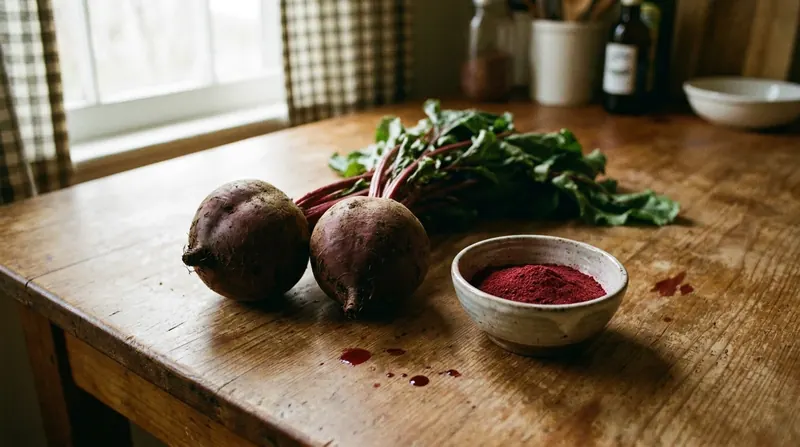
Beet root is rich in dietary nitrate, which the body turns into nitric oxide, the body's own widener of blood vessels, and that's the whole reason beets became a supplement.
The study behind this line gave older adults, average age about 75, a day of a high-nitrate diet that included beet juice, and a day of a low-nitrate diet, and scanned their brains for blood flow.
The high-nitrate day didn't change overall blood flow to the brain, but it did raise blood flow in one region, the frontal white matter. [4]
What did that study measure?
Blood flow, on a scan, after a day of nitrate-rich food and juice.
Is 300 milligrams of powder the same as that day?
No. A glass of beet juice holds many times the nitrate of 300 milligrams of powder, which is about a tenth of a teaspoon.
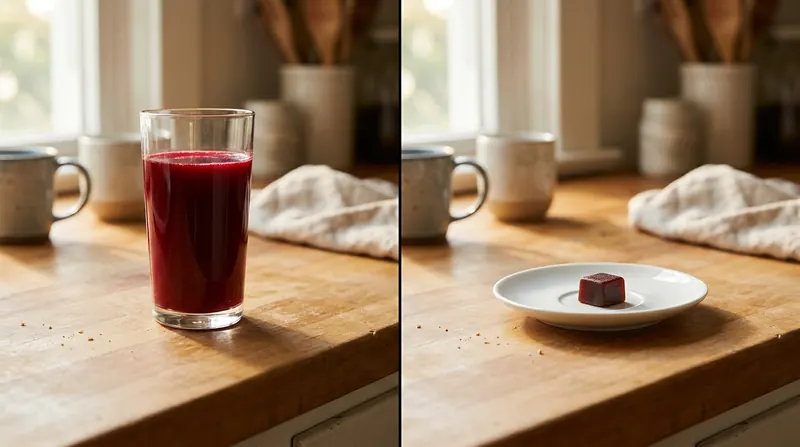
Nobody in that study was tested on memory, and nobody in it ate a chew.
The beet line is a real vegetable at a small dose, and its study is about circulation, not recall.
Beet root at 300 milligrams: a day of beet juice moved regional blood flow on a scan in older adults. A tenth of a teaspoon of powder isn't a glass of juice, and blood flow isn't memory.
What Has Actually Been Studied, Put Plainly
Let's put the three lines side by side, because this is where a sales page usually gets loud and this one won't.
So what can I fairly say about the benefits?
Here's what has been studied, in plain words.
- A grape polyphenol, at a higher dose than the chew, went with better word recall over six months in one small group of adults over 50.
- Coffee fruit, at the chew's exact dose, raised a blood protein linked to nerve cells for two hours.
- A day of beet juice and nitrate-rich food raised blood flow in one region of the brain on a scan.
And what can't I say?
That the chew will sharpen your memory, or that you'll find the actor's name faster by next week.
No study has tested these three ingredients together in anyone, and none tested this chew.
What you're buying is three studied ingredients in a form you'll actually take, not a study result.
That's less than the front of the bag suggests, and more than a lot of bags on the same shelf can say.
Every line is weighed, every study is real, and you now know what each one measured.
Questions I Put to the Label and the Seller
Before I'd buy anything, I like to ask the package a few plain questions.
Here are the answers, straight from the panel and from GNC's own pages.
How many chews are in a bag, and how long does it last?
Thirty chews, one a day, so one bag is one month.
What's a serving?
One chew, which carries all three lines at the amounts on the panel.
Is it vegan, and is there gluten or dairy?
GNC's listing marks it vegan and vegetarian, without gluten, lactose or dairy, and non-GMO.
What is "Verti-te"?
It's a trademark on the resveratrol, the brand name of the supplier's grape-derived form.
How many calories?
Twenty per chew, with four grams of carbohydrate.
Does GNC make any promise beyond the name?
No. Its page prints the name "Memory + Focus" and the standard FDA sentence, and that's all.
I actually like that.
A seller that doesn't pile promises on the page leaves you room to judge the thing for yourself.
Who answers the phone if something goes wrong?
GNC's customer service, at a toll-free number seven days a week, with a street address in Pittsburgh printed on its pages.
Two Grams of Sugar, and the Reason It's a Chew
The line that isn't an ingredient, and still belongs on the page.
Two grams of added sugar per chew, from tapioca syrup and cane sugar, printed on the panel, with a stevia extract to finish the job.
That's less than half a teaspoon, and it's why the thing tastes like a soft candy and why the reviews mention the taste first.
Thirty chews is sixty grams over the bag, which is about fifteen teaspoons across a month, or half a can of soda's worth spread thin.
Two grams is a small number and a real one.
Should that worry me?
If you're counting your sugar closely, count it. If you aren't, it's about a fifth of a cookie.

Two grams of sugar per chew is the price of the format. It's on the label, and it's the reason a capsule would have been cheaper.
A Normal Tuesday With the Pouch on the Counter
Let me walk you through what using this actually looks like, because it's simpler than the bag makes it sound.
You come down, start the coffee, and the pouch is where you left it, next to the sugar bowl.
You tear the wrapper off one chew, eat it while the coffee drips, and fold the top of the bag over.
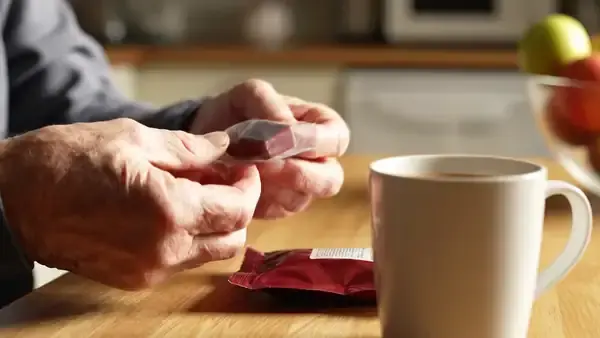
That's it.
No water, no measuring, nothing to shake.
What if I'm out the door early?
Each chew is wrapped on its own, so one fits in a shirt pocket for the drive or the walk.
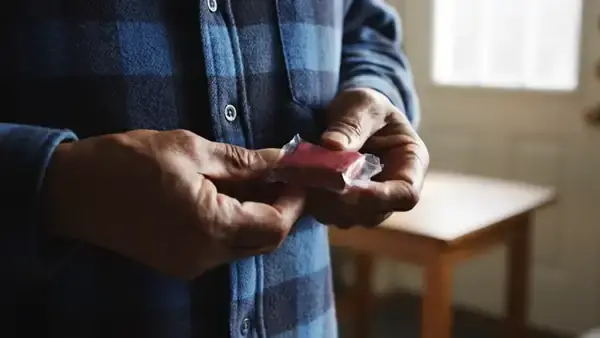
Then the rest of the morning is the morning you already have.
The walk around the block, the paper, the errand to the hardware store.

Maybe you meet a friend at the park bench at ten, the way a lot of men do.
You talk about the ballgame, your grandkids, a name from the old job that neither of you can pin down at first.

Is the chew doing something right then?
I can't tell you that, and I'd be wary of anyone who says they can.
What I can tell you is how to find out for yourself, honestly, in a month.
It's the notebook.
Every evening, one line.
Not "sharper" or "foggier," but what you were doing at ten, and how it went.

Thirty lines about your own mornings will tell you more than any page, mine included.
What about the rest of the day?
Nothing changes, and that's the point.
Lunch is lunch.
The afternoon is whatever it was going to be: the yard, the grandkids, a nap in the chair if you've earned one.
In the evening, you write your one line and close the notebook.
The pouch stays by the coffee maker, folded over, waiting for tomorrow.
A habit that costs you ten seconds a day is one you'll actually keep for thirty days.
And thirty days is exactly what you need to judge it fairly.
If You Do Buy It: One Bag, One Chew With the Coffee, Thirty Days, One Notebook
If you're going to spend the money, spend it as a test with a date on it, and use the seller's return page as the safety net it is.
- Buy one bag from GNC, not a subscription. Thirty chews is a month, and GNC's thirty-day window covers a bag you've opened.
- One chew with the morning coffee, every day, at the label's dose. The label says one, and nothing here was tested at two.
- Keep the coffee exactly as it was. The chew adds no caffeine worth counting, so nothing about your morning should change but the chew.
- Write one line a day in a notebook, as above.
- Take the pouch to the pharmacist before day one if you take anything daily. Beet nitrate and resveratrol are worth a minute at the counter.
- On day thirty, read the thirty lines. If they read better than the month before, you've found a forty-dollar habit; if they don't, GNC's return page takes back a used bag within thirty days of the order, minus shipping.
Look at that list the way I do.
Four of the six things cost nothing.
The bag is the one you'll pay for, and the notebook and the return page are the ones that protect you.
How to Read Your Thirty Lines on Day Thirty
A notebook is only useful if you read it fairly.
Here's how I'd do it.
What should I compare it to?
The month before, as best you can remember it, or better yet, a week of lines written before you open the bag.
If you have the patience, start the notebook seven days early.
Then you've got something honest to hold the chew's month up against.
What counts as a good line?
Something plain and specific: "Found the word for the plumber's tool on the first try," or "Read two chapters and remembered them at supper."
What shouldn't I count?
One bad day after a short night, or one good day after a long walk.
Look at the whole month, not the best day or the worst.
If the month reads about the same as before, that's an answer too, and it's a useful one.
And if I can't tell?
Then you can't tell, and a return window exists for exactly that.
Be as honest with the notebook as this page tried to be with you.
One Short Conversation Before Day One
There's one more step I'd take, and it costs nothing.
Take the pouch to the pharmacist the next time you're picking something up.
Why bother, for a chew?
Because beet nitrate and resveratrol are both worth a mention if you take anything daily.
It's a two-minute question at the counter.
Show the panel, name what you take, and ask whether the chew is a sensible addition.
The ingredient guide at the foot of this page has each line written out, so you can print it and bring it along.
A two-minute question is the cheapest part of this whole test, and the one I'd skip last.
Who It Suits, and Who It Doesn't
This is worth a look if:
- You want three real lines in a chew you'll actually take, and you've now read what each of the three studies measured.
- You'd rather chew something than swallow a capsule, and two grams of sugar a day doesn't trouble you.
- You want a seller with a street address in Pittsburgh, a toll-free number, stores you can walk into, and a return page that takes back used product.
- You can hold two ideas at once: three studied ingredients, no memory result at this dose.
- You'll buy one bag, take one chew a day, and run thirty days with a notebook and the return window open.
Give it a miss if:
- You want the resveratrol of the study. That's 200 milligrams; the chew is 150.
- You're counting sugar closely. Two grams a chew, sixty a bag.
- You want something aimed at a condition a clinician has named. This is a dietary supplement.
- You take anything daily and haven't asked a pharmacist yet. Ask first.
- You want shipping at no charge on one bag. It's below GNC's line.
What won't it do, in a sentence?
It won't give you a memory result at its own dose, it won't stand in for a glass of beet juice, and it won't come without sugar.
If that list annoys you, better now than when the bag is empty.
Three Fair Objections, and My Honest Answers
There are three fair objections to this bag, and I had all three myself.
Let's take them one at a time.
"Forty dollars for thirty chews is a lot."
It is about a dollar and a third a morning, at the list price the day I read the page.
That's less than the coffee-shop cup a lot of us buy without thinking, and more than a bag of beets from the grocery store.
The fair way to judge it is one bag, one month, one notebook, with the return window open.
GNC often runs a promotion in the cart, and the price changes from week to week.
So I don't print one; you'll see the current number on the seller's page.
"I don't want candy at my age."
Fair enough.
It is candy-shaped, and it knows it.
Two grams of sugar is the price of a chew you'll remember to eat, and if that trade doesn't suit you, a capsule of something else will.
The taste is blueberry and pomegranate over a soft caramel texture, with beet underneath.
Most reviewers like it, and one of them simply says she eats it on her way to work.
"A month isn't long enough to know anything."
You're right, and I won't pretend otherwise.
The one memory study ran six months, at a higher dose.
A month won't reproduce it, and I'd rather tell you that before you order than after.
What a month can tell you is whether the habit fits your mornings.
If it does, you'll decide about a second bag with thirty lines in front of you, not with a headline.
"Why not just eat beets and drink grape juice?"
Honestly, you should eat beets, and I'd never talk you out of it.
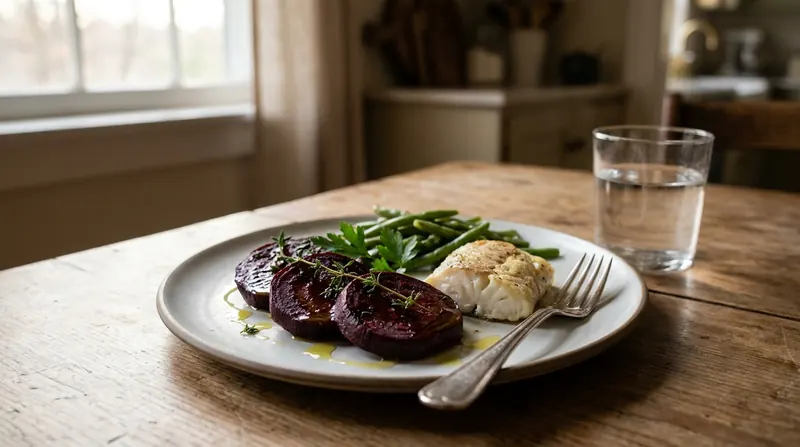
A roasted beet at supper carries more of everything than a tenth of a teaspoon of its powder.
Grapes are good food too.
But a grape won't hand you 150 milligrams of resveratrol, and the coffee fruit extract isn't something you can buy at the produce counter.
The chew puts three weighed amounts in one place, and whether that's worth a dollar and a third a morning is your call, not mine.
Price, format and time are the three honest objections, and each has an honest answer: one bag, one chew, thirty days, and a return page that means it.
Where It's Sold, and a Return That Takes Back an Opened Bag
The chew is sold by GNC on its own website, and that's the only place this page links to.

The two companies are easy to find.
The chew is made for Human Power of N, trading as HumanN, with its office on Capital of Texas Highway in Austin, printed in GNC's licensing tab.
The seller is GNC Holdings, LLC, with its customer-service address on Hopper Place in Pittsburgh, a toll-free number that answers seven days a week, and an email, all printed on its contact and privacy pages.
GNC's listing marks the chew without gluten, without dairy, vegan and non-GMO.
How does shipping work?
GNC ships to all fifty states; standard shipping is a flat charge of about thirteen dollars, at no charge above the seller's order line, and one bag is below that line.
You can also have it sent to a GNC store for pickup.
And if I don't like it?
Read this twice, because it's better than most.
If you're not satisfied, you can return the item within thirty days of the order date for a refund of the purchase price, minus shipping and other charges.
GNC says the item can be used or unused, in good condition, in its original packaging where possible.
It's a real refund with a real address, and it takes back a bag you've opened.
Nothing after thirty days, and the shipping doesn't come back with it.
Made for HumanN of Austin, Texas · sold by GNC Holdings, LLC, Pittsburgh · 30-day return from the order date, opened or not, refund minus shipping
Three Hundred and Fifty-Five Ratings, an Average of Four, and a Widget That Prints Its One-Star Share
GNC's page carries a review widget with 355 ratings and an average of four stars, and it prints the breakdown: 53 percent five stars, 14 percent four, 21 percent three, 5 percent two, and 8 percent one.
That's more honest than most widgets: a fifth of the people who rated this chew gave it three stars, and one in twelve gave it one.
The reviews themselves, the widget notes, were originally posted on the maker's own site, and they carry no confirmed-purchase mark from GNC.
So this page marks them as what they are: real reviews published on the seller's page, not confirmed purchases.
I read the ten most recent and kept five, including one at four stars.
These are real customers, quoted word for word from the seller's product page; the small photos beside them are illustrations, not the reviewers.

I am 85 years old I play cards I can figure my score without help I do fillin puzzles and Word Search every day This has helped me so much I am Blessed.

I noticed a difference in a few weeks. I was thinking more clearly and came up with solutions to situations more easily. The difference is very subtle, but if one is in tune with their body and brain, I think you'll notice improvement. I'm in my 70's.

Still early but finding words a bit sooner than the previous few years.

i have autoship on this, take 2 a day & tastes so good, as the name says, it really helps my memory esp focus since am now 71, thank you for this great product!

Their tasty and I love that you can grab and eat on your way to work.
Read those the way I did.
How should I read a star breakdown like this one?
Look at the middle, not just the top.
Half the ratings are five stars, which tells you plenty of people like it.
A fifth are three stars, which usually means "fine, nothing special," and that's a useful thing to know before you pay.
The one-star slice is small and real.
Some people won't like the taste, some won't notice anything, and a month is short.
Marcy is 85, plays cards and does the word search every day, and credits the chew.
The cards and the puzzles are the best-supported thing in her review, and she's doing them anyway.
Sabrina, in her seventies, says the difference is very subtle and you'd have to be in tune with yourself to notice.
That's the most honest sentence on the page.
Margie says it's early and words come a bit sooner.
Irma is 71, takes two a day, which is twice the label's direction, and likes the taste.
The four-star reviewer likes that she can grab one on the way to work.
That's a review of the format, and the format earns it.
Nobody I kept describes a trial result, because the trials didn't measure one at this dose.
And 8 percent of the 355 gave it one star, which the seller's widget is honest enough to print and this page is honest enough to repeat.
The ingredient guide linked at the foot of this page goes through all three lines and the sugar: what each one is, what each study measured, and what to ask the pharmacist.
Print it and take it with you if you take anything daily.
What Readers Ask Me Before Their First Bag
Questions readers ask
Is this medicine?
No. It's a dietary supplement in a soft chew, made for HumanN and sold by GNC.
Does it have caffeine?
The panel prints no caffeine figure; the extract comes from the cherry, not the bean.
Which line has a memory result?
Only resveratrol, at 200 milligrams over six months in 46 overweight adults; the chew has 150.
What does it taste like?
Blueberry and pomegranate over a soft caramel texture, with a little beet underneath.
Can I take two a day?
The label says one, and nothing here was tested at two.
Can I take it with what I already take?
Take the pouch and the ingredient guide to your pharmacist first.
Are the reviews confirmed purchases?
No. They're real and public, first posted on the maker's site, and this page doesn't mark them otherwise.
What if I don't like it?
Return it to GNC within thirty days of the order, used or unused, for a refund minus shipping.
Everything Above, in Sixty Seconds
- A bag of thirty blueberry-pomegranate soft chews made for HumanN of Austin, Texas, and sold by GNC: beet root powder 300 mg, resveratrol 150 mg and coffee fruit extract 100 mg per chew, with two grams of added sugar. One a day.
- Coffee fruit: a blood protein for two hours in ten people, at this dose. [2] Resveratrol: a six-month memory result in 46 overweight adults, at 200 mg. [3] Beet: a day of juice moved regional blood flow on a scan. [4]
- Three hundred and fifty-five ratings, average 4.0, 8 percent one-star; the reviews are syndicated from the maker and carry no purchase mark.
- Ships to all fifty states for a flat charge; thirty-day return, used or unused, minus shipping.
- The honest use: one bag, one chew with the coffee for thirty days, a notebook, and the return window open.

What a Soft Chew Is Actually Worth
Here's the whole thing in one breath.
Three real lines in a well-made chew from a big company, sold by a bigger one with a street address and stores.
Three real studies, one of blood, one of blood flow, one of memory at a dose the chew doesn't reach.
Two grams of sugar, a taste most people like, and one in twelve who gave it a single star.
And a return page that takes back a bag you've opened.
Not because of the front of the bag. Because you'll know exactly what each study measured.
If you're a man who wants three studied ingredients in a chew he'll actually take with his coffee, tested honestly over thirty days, that's worth one bag.
The notebook is a better judge than I am, and the return page is a better safety net than most.
A pouch of thirty, and thirty days to decide
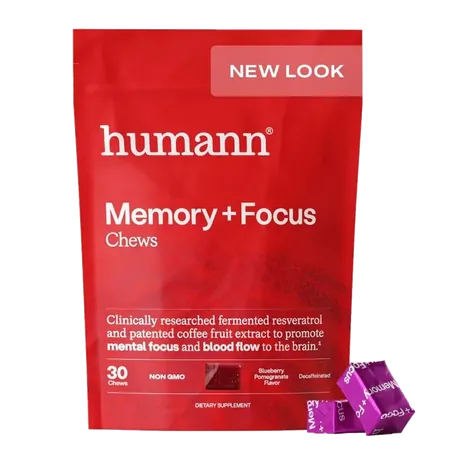
One soft blueberry-pomegranate chew a day of beet powder, a grape polyphenol and coffee fruit, made for a Texas company and sold by GNC.
SEE THE POUCH ON GNC'S PAGEMade for Human Power of N (HumanN), Austin, Texas, and sold by GNC Holdings, LLC, Pittsburgh · Standard shipping is a flat charge; at no charge above GNC's order line, which one bag is below; store pickup available · GNC 30-day return, used or unused, refund of the purchase price minus shipping
P.S. If you take one thing from this page, take the two numbers.
One hundred and fifty milligrams of resveratrol, three quarters of the one memory study.
Two hours, the length of the coffee fruit study the front of the bag leans on.
P.P.S. If something about your memory has been bothering you for a while, talk to your own clinician before you buy anything.
A chew with the morning coffee is a small habit, and it was never meant to answer that kind of question.